MEXT scholarship · College of Technology (KOSEN)
KOSEN · Mathematics, Physics & Chemistry
Worked solutions in English
English worked solutions to four years of MEXT KOSEN mathematics and science papers. Follow the intermediate calculations, diagrams and checks in three separate PDFs. Use them alongside the free official question papers. This is the College of Technology scholarship examination, not an ordinary Japanese university-transfer examination.
2016–2019 · Mathematics, Physics & Chemistry
110 major problems · 231 worked questions · 235 answer fields · 188 pages
English / A4 PDFs
See included papersSample worked solutions
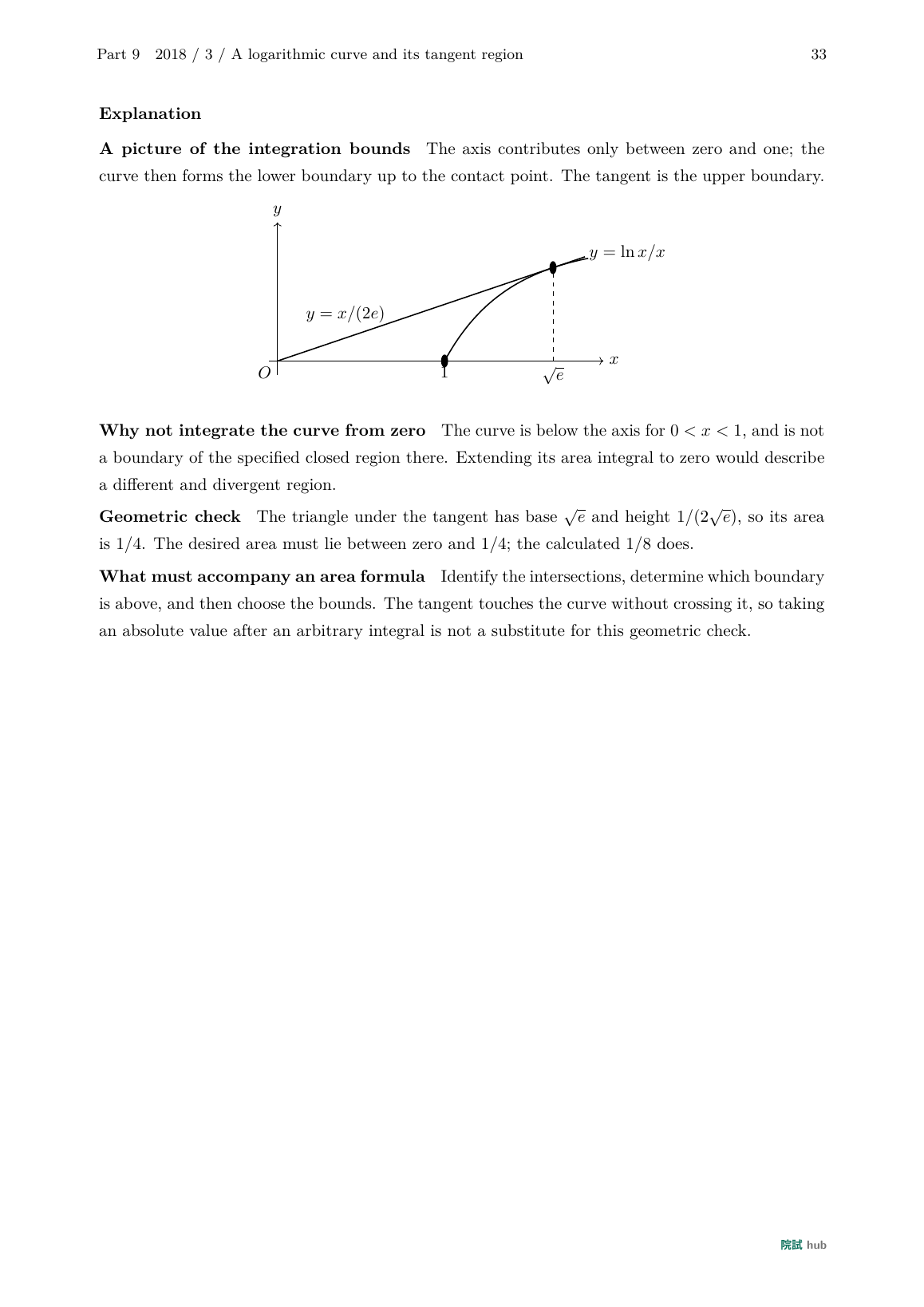
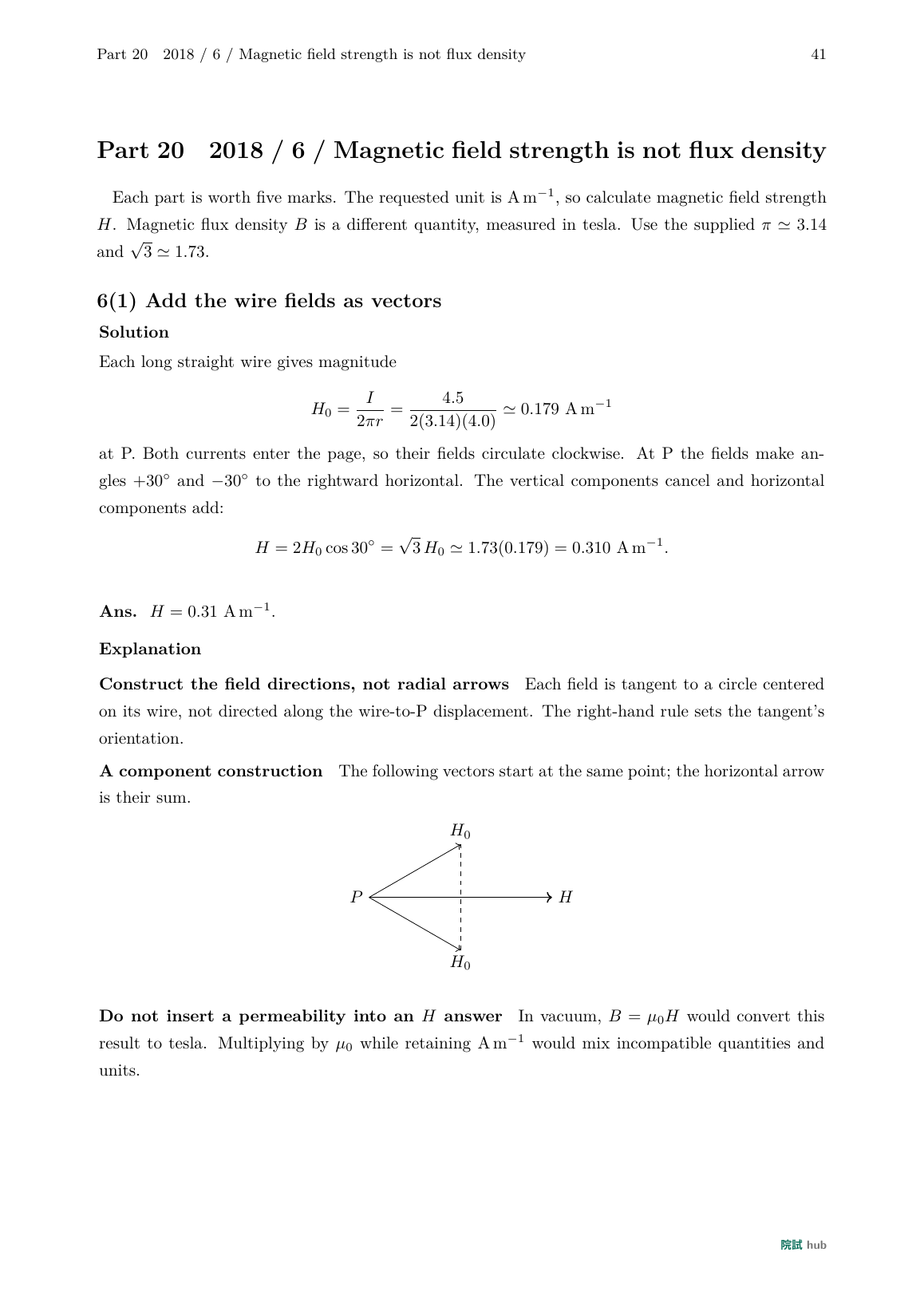
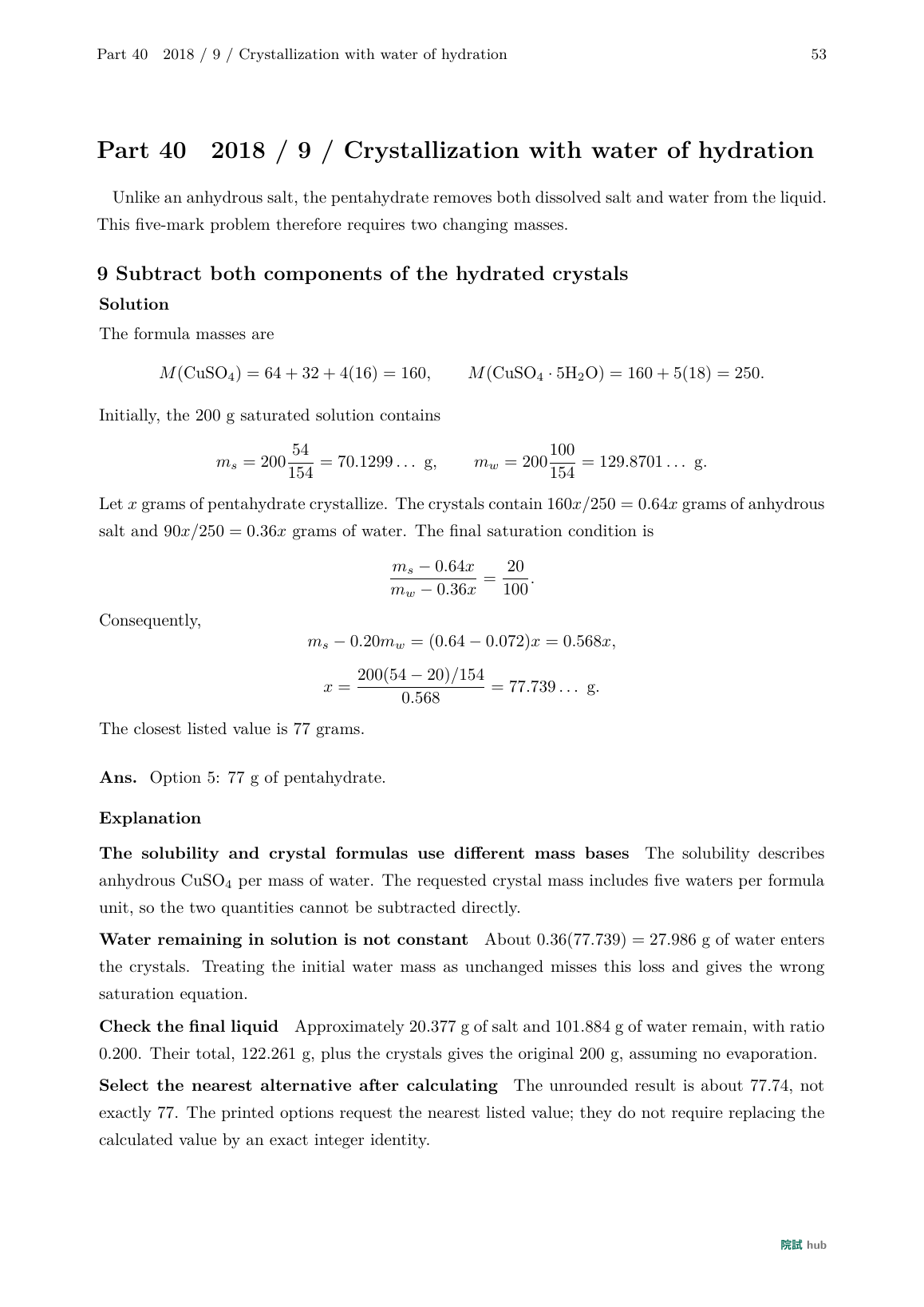
Open the 12-page sampleThe 12-page sample includes all three covers and six complete major problems: Mathematics 2018 problem 3; Physics 2018 problem 6; Chemistry 2017 problems 14 and 18, 2018 problem 9 and 2019 problem 20. It shows calculations, diagrams, explanatory notes and a disclosed official-key discrepancy. Printed page numbers refer to the named volume. These are actual pages from the book. Select an image to read it at full size.
Included KOSEN papers and topics
| Paper | Topics | Pages |
|---|---|---|
| 2016 · Mathematics | Algebra, trigonometry, vectors, integration and matrix multiplication | 2–12 |
| 2017 · Mathematics | Cubic equations, logarithms, sequences, matrix constraints and exponential curves | 13–22 |
| 2018 · Mathematics | Equations, trigonometry, sequences, matrices and a logarithmic tangent region | 23–33 |
| 2019 · Mathematics | Algebra, vectors, matrix powers and integration of trigonometric functions | 34–44 |
| 2016 · Physics | Action and reaction, oscillations, waves, ideal gases and charged-particle motion | 3–16 |
| 2017 · Physics | Connected bodies, collisions, calorimetry, electric circuits and traveling waves | 17–30 |
| 2018 · Physics | Friction, force balance, gas mixing, Doppler shift, circuits and magnetic fields | 31–44 |
| 2019 · Physics | Vertical motion, springs, rebounds, waves, thermodynamics and potential differences | 45–58 |
| 2016 · Chemistry | Periodic trends, molecular polarity, pH, gases, electrolysis and ester equilibrium | 4–23 |
| 2017 · Chemistry | Molecular structure, concentrations, redox titration and isomer counting | 24–43 |
| 2018 · Chemistry | Gas mixtures, hydrated crystals, weak acids, complexes and organic structures | 44–63 |
| 2019 · Chemistry | Electron-count conventions, neutralization, redox, gases and molecular formulae | 64–83 |
Twelve papers across 2016–2019. Mathematics has 12 major problems and 73 questions; Physics has 28 major problems, 78 questions and 82 answer fields; Chemistry has 70 major problems and 80 questions. The three PDFs retain each paper's year and question numbering. KOSEN papers are distinct from undergraduate and specialized-training-college papers. The 188-page total includes covers, reading notes and contents. Page ranges use the printed numbering within each volume.
Who this is for
Applicants practising the MEXT College of Technology (KOSEN) scholarship papers who already know secondary-school algebra, trigonometry, calculus and the relevant science. Work from the official question paper, then use this companion to identify an omitted transformation, condition, unit or chemical species. Choose your science preparation according to your application field; this set contains both sciences, not a claim that every applicant must take both.
Not included
No Japanese or English language-test solutions, undergraduate Mathematics A or B, specialized-training-college papers, ordinary transfer examinations or papers after 2019. No question translations, personal tutoring or scholarship guarantee. Confirm current eligibility, dates and science selection with the guidelines and your Japanese embassy or consulate.
Which science does your field require?
The 2027 KOSEN guidelines require Mathematics and both language tests, plus the science determined by the chosen field. Materials Engineering uses Chemistry. Mechanical, Electrical and Electronic, Information/Communication/Network, Architecture, Civil and Maritime Engineering use Physics.
For Other Fields, the accompanying field determines the science; applicants choosing only Other Fields can specify either one. Check section 8 before planning revision. This purchase includes both science books, but they are not both compulsory for every applicant. Japanese and English language-test explanations are not included. Calculators are not permitted in the written examinations.
Three errors that a correct formula alone will not prevent
A tangent is not the whole boundary
In Mathematics 2018 problem 3, the tangent passes through the origin, but the logarithmic curve crosses the axis at x = 1. Integrating that curve from zero would describe a different, divergent region. The solution finds the contact point, checks which boundary is above, then subtracts the curve’s integral from the triangle under the tangent.
Field strength is not flux density
Physics 2018 problem 6 asks for H in amperes per meter. Multiplying by the permeability would instead produce B in tesla. The diagram constructs the two field directions before adding their components; it does not treat field arrows as radial displacements from the wires.
Crystallization changes the denominator
Chemistry 2018 problem 9 concerns a pentahydrate. Each gram of crystal removes 0.64 grams of anhydrous salt and 0.36 grams of water. Accounting for both gives about 77.74 grams of crystals; 77 grams is the nearest listed option, not an exact integer identity. The explanation also checks the remaining solution’s salt-to-water ratio.
When the printed conditions and the key disagree
Mathematics 2016 problem 1(10) prints a limit at zero. Over its real domain the limit is √5, while the official key gives 3/2, the value obtained at positive infinity. The book shows both limits. Physics 2017 problem 4(4) contains incompatible ideal-gas data: the first-law calculation rounds to the key’s 0.14 cubic meters, while other printed conditions do not agree. The explanation identifies which conditions each result uses.
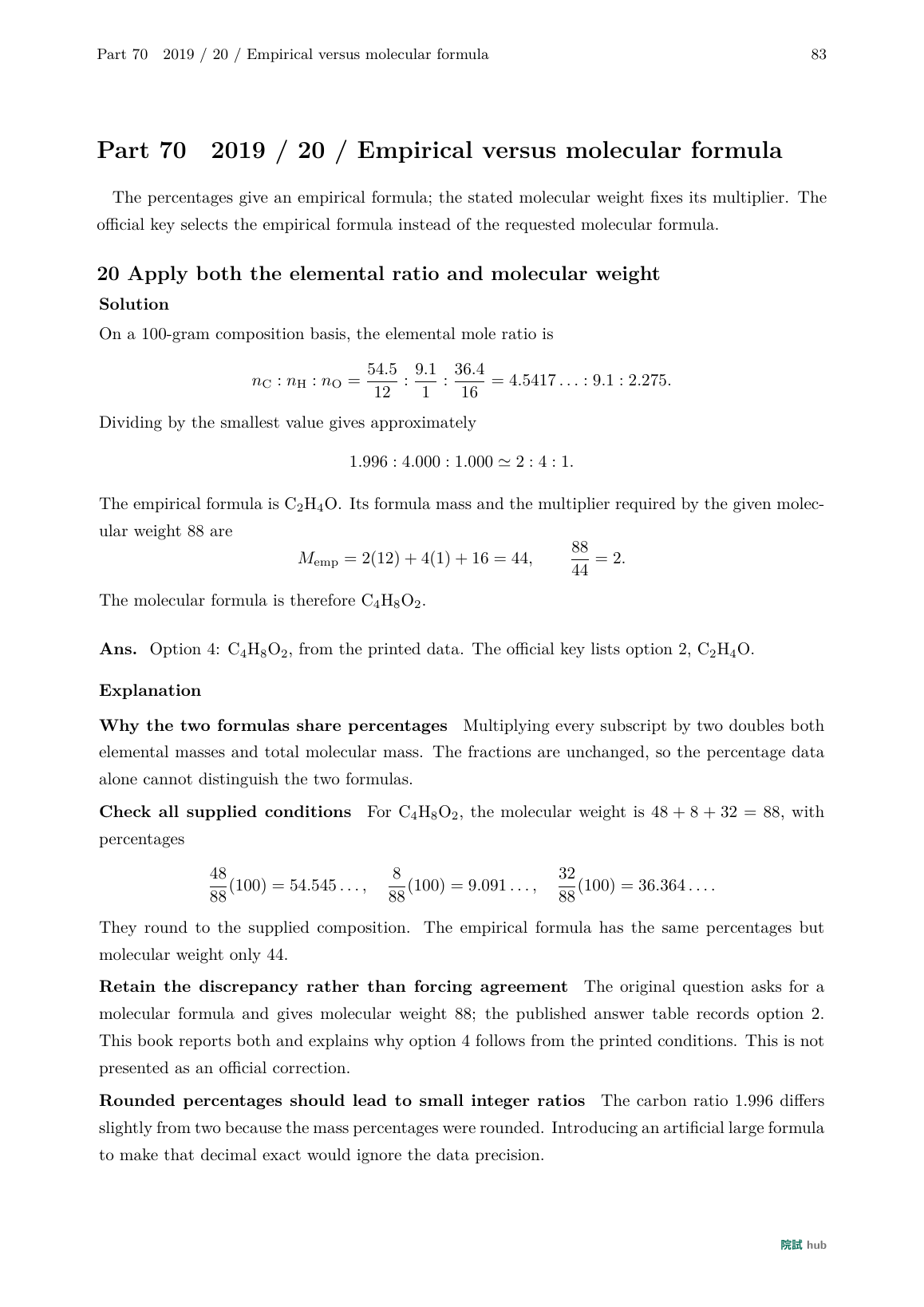
Chemistry 2019 problem 20 gives the empirical formula C2H4O and molecular weight 88, hence molecular formula C4H8O2, option 4. The official key instead lists option 2, C2H4O. The complete explanation is in the free sample. The chemistry volume also distinguishes the Japanese school convention for neon’s valence-electron count from its eight outer-shell electrons, and identifies the inconsistent gas constants printed in 2019.
These are explanations of the supplied papers, not announcements of official MEXT corrections. Where a model needs an unstated assumption, such as acidic permanganate reduction, that assumption is stated beside the calculation.
Preparing for an undergraduate scholarship instead?
Use the separate undergraduate Mathematics A book for humanities preparation, or the undergraduate Mathematics B, Physics and Chemistry set for Natural Sciences A. Their questions differ from KOSEN; they are not alternative covers for this set.
Free official KOSEN questions and answer keys
Choose 2016, 2017, 2018 or 2019, then College of Technology Students and the relevant subject on the official page. Do not substitute Undergraduate Students or Specialized Training College papers. The paid books provide original worked explanations; question statements, translations and source figures remain outside the books.
Independently written by InshiHub, not an official MEXT / Study in Japan publication and not affiliated with MEXT / Study in Japan. For corrections, email the subject, year, question number and issue to inshihub.com@gmail.com. About InshiHub (Japanese)
Payment, downloads and returns
One-time purchase, not a subscription. The listed price is in Japanese yen (JPY), not US dollars. Available payment methods and any local-currency quote appear at Stripe Checkout. Your bank may charge currency-conversion fees.
Download all 3 PDFs from the purchase-completion page after payment. Enter an email address you can receive mail at and retain the purchase email. Signed-in purchases can be retrieved from your account. Some delivery, email and account instructions are in Japanese.
Digital purchases cannot be cancelled or returned for a change of mind after payment. For a damaged file, non-delivery, a material mismatch with the description or a duplicate charge, we will provide a working file or the corresponding refund after verification. Contact the email above using your purchase email address and describe the product and issue.
Seller, contact details and full sales terms (Japanese) · Privacy policy (Japanese)