MEXT scholarship · Undergraduate applicants
Natural Sciences A
Worked solutions in English
Work through four years of MEXT undergraduate Mathematics B, Physics and Chemistry with English explanations of the method, intermediate calculations and answer checks. One purchase includes three separate PDFs, used alongside the freely available official question papers.
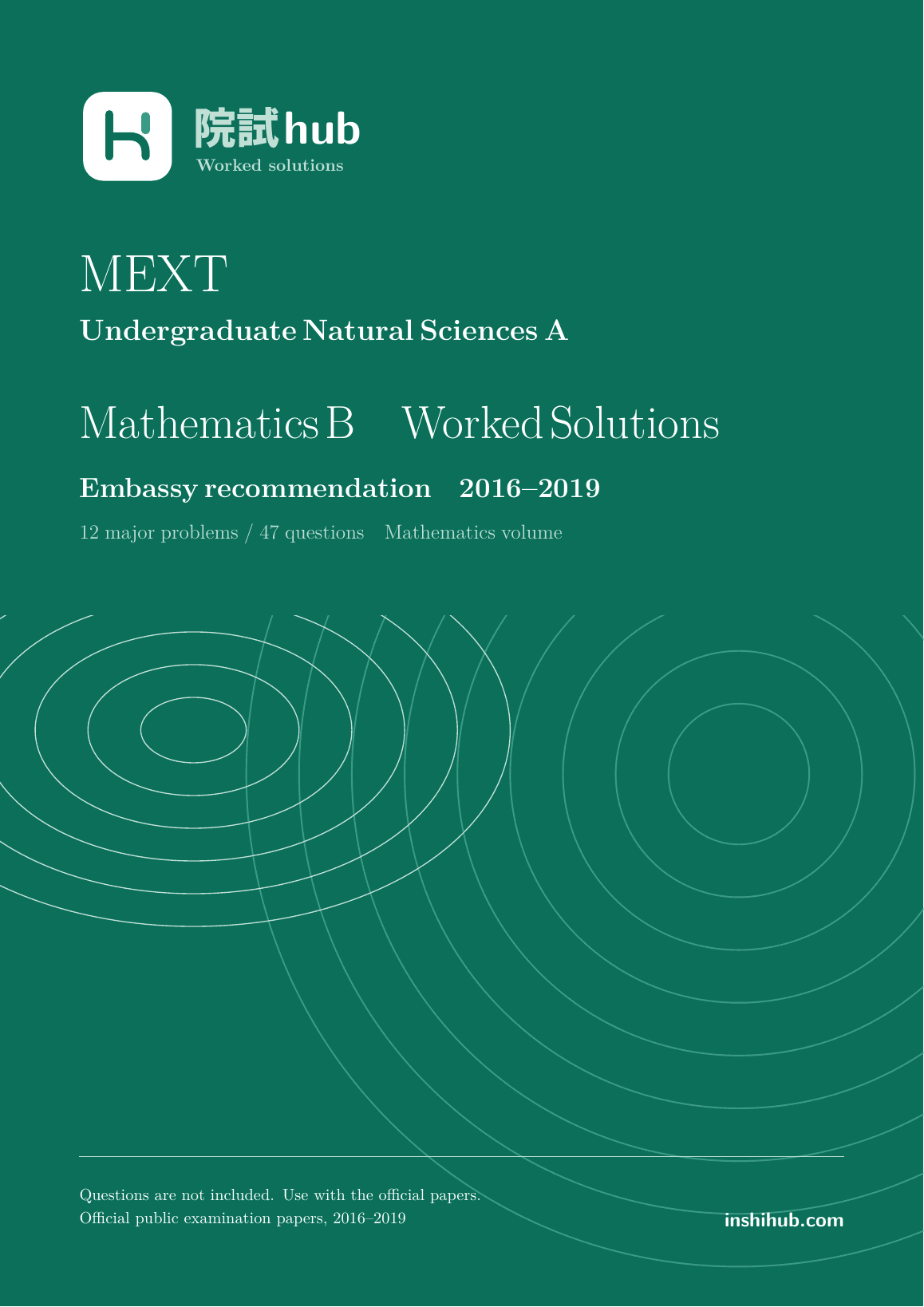
2016–2019 · Mathematics B, Physics & Chemistry
60 major problems · 248 worked units · 184 pages
English / A4 PDFs
See included papersSample worked solutions
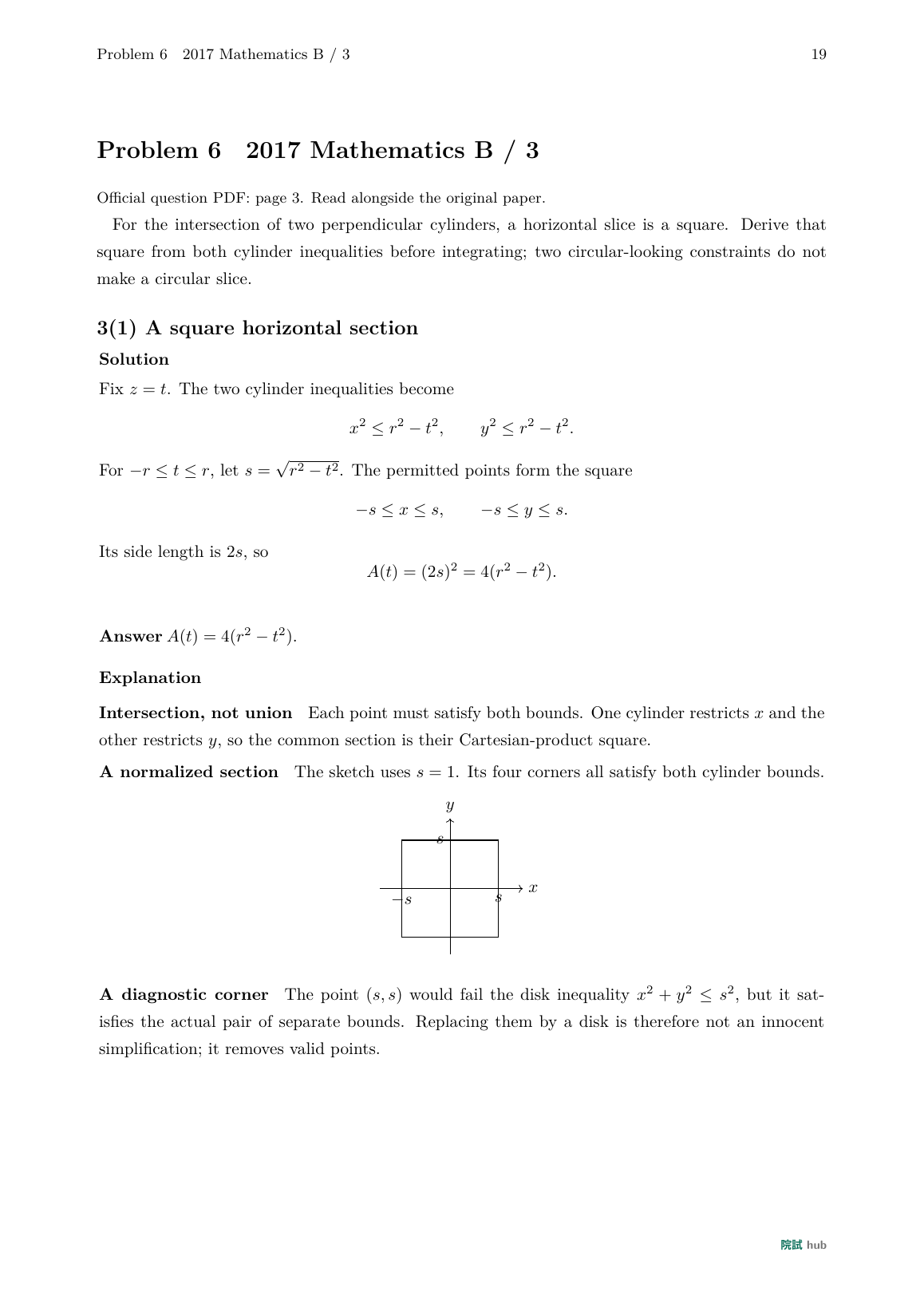
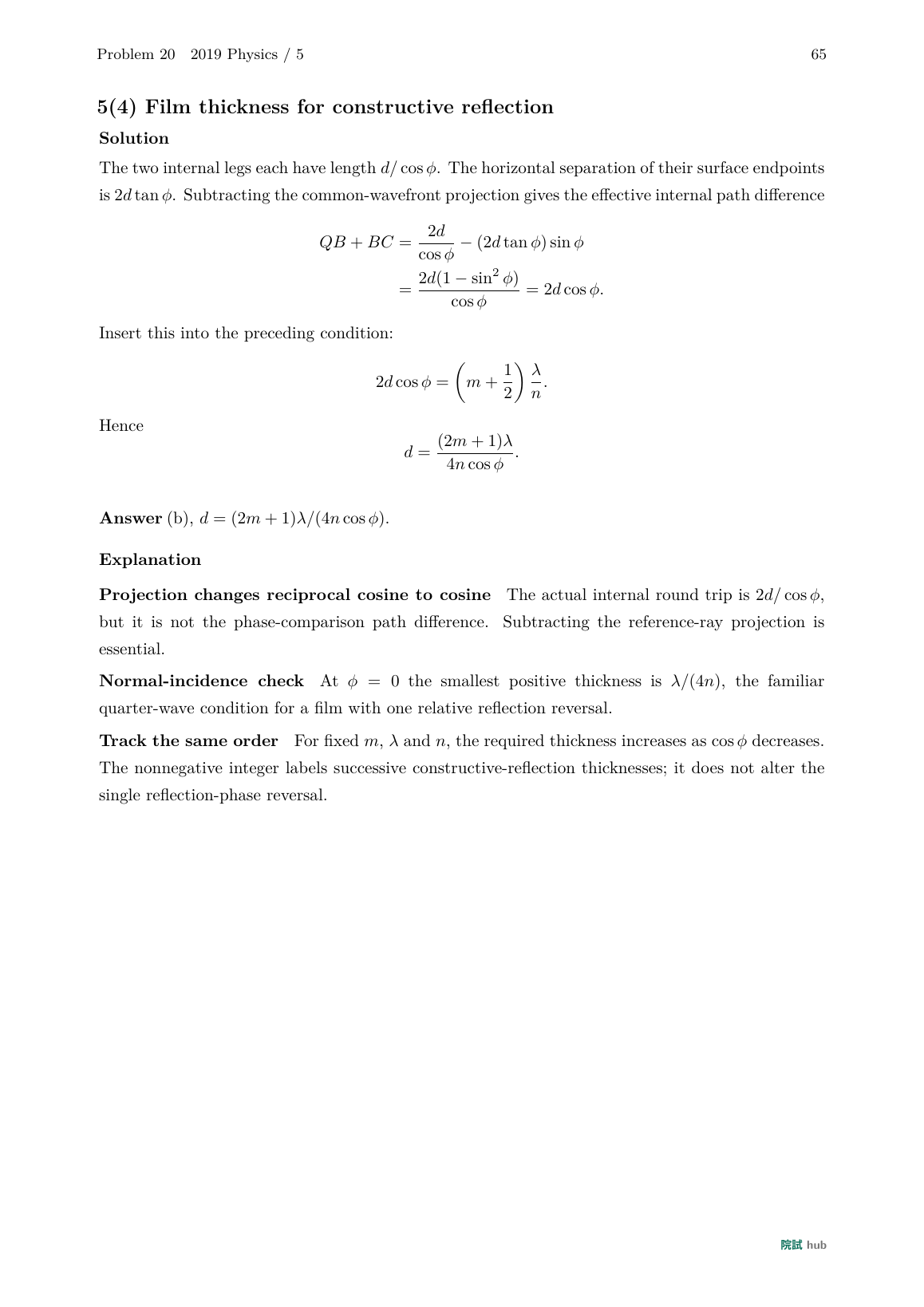
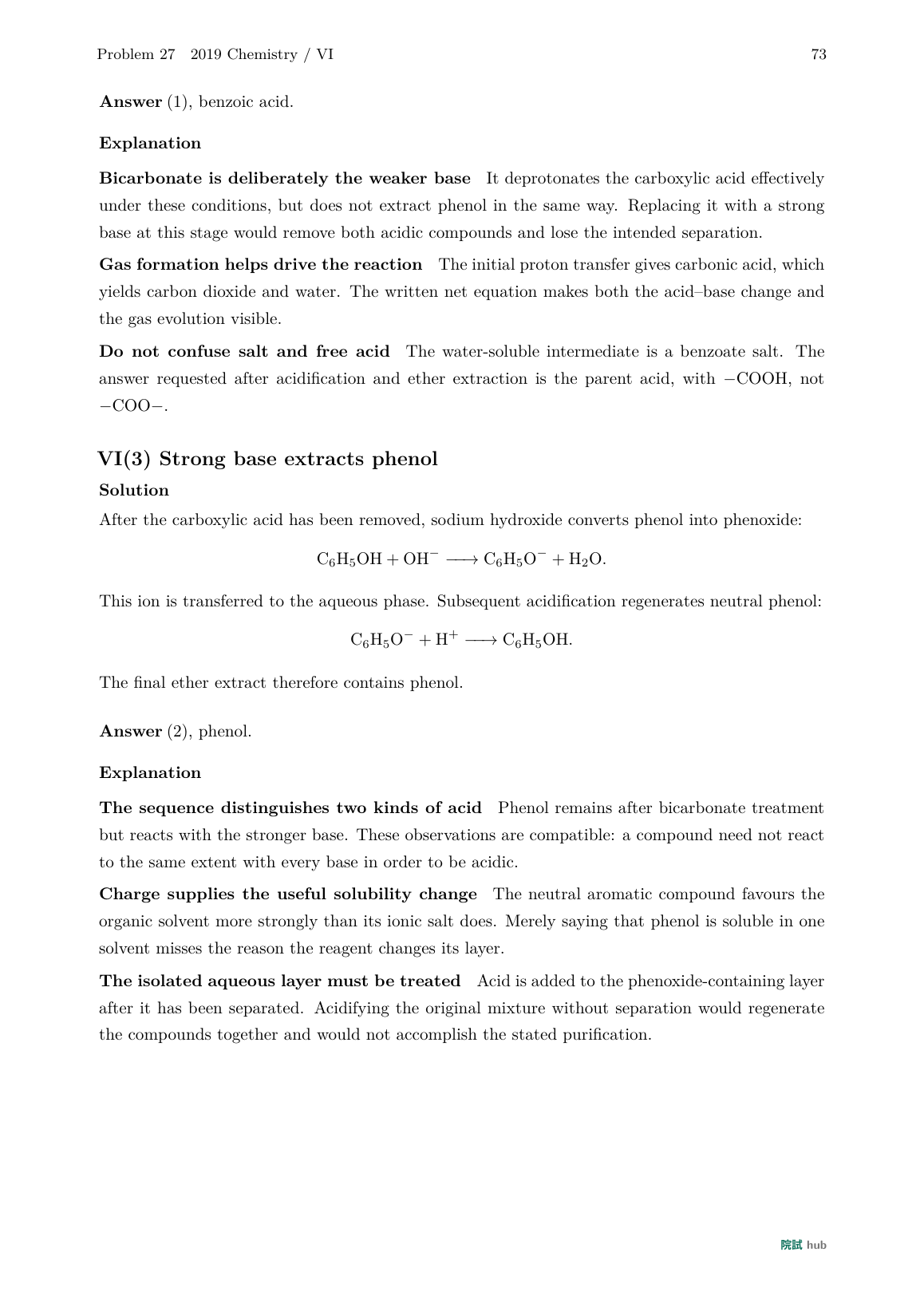
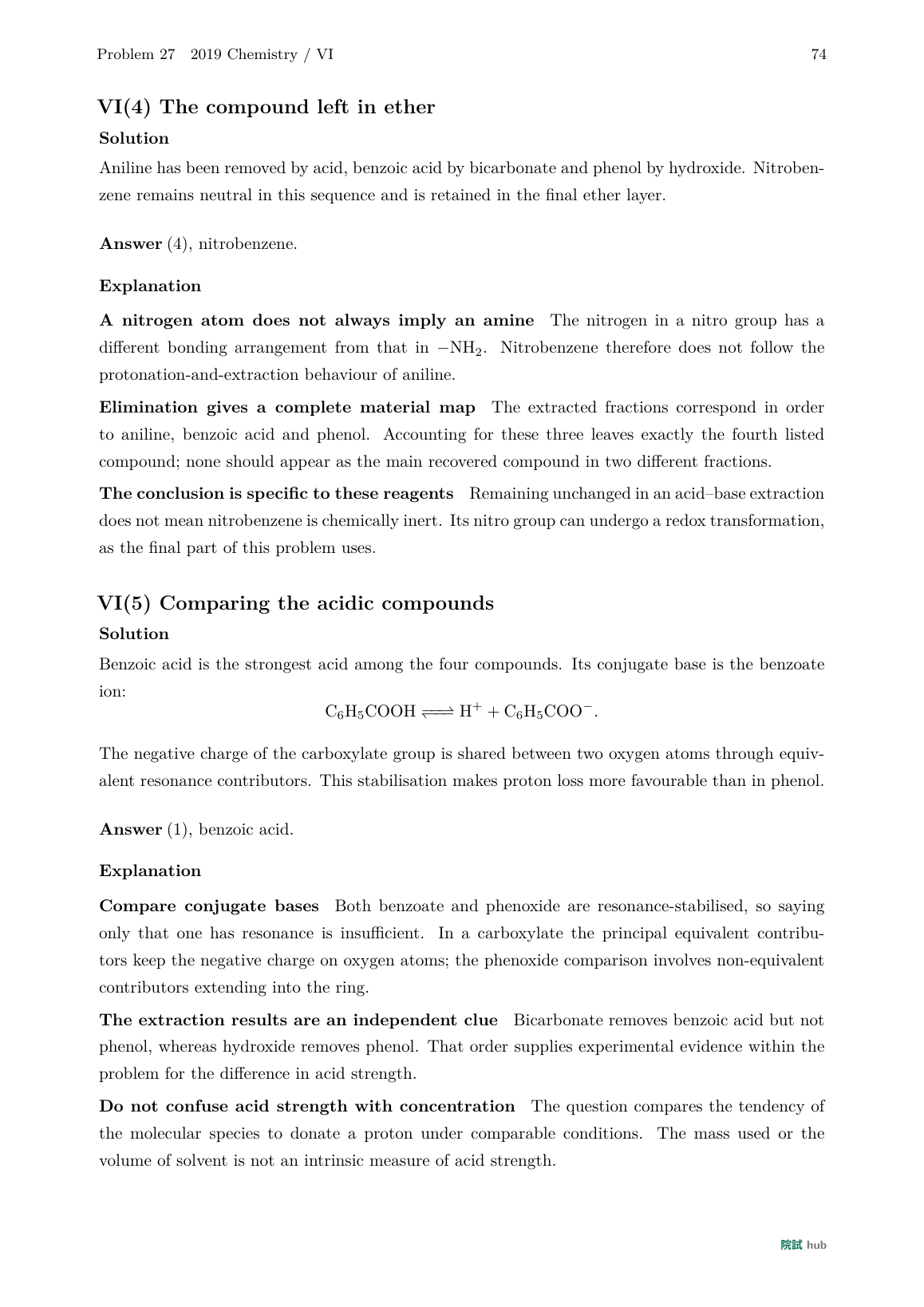
Open the 12-page sampleThe 12-page sample includes the three actual covers, the complete 2017 Mathematics B problem 3 on intersecting solids, the complete 2019 Physics problem 5 on thin-film interference, and the complete 2019 Chemistry problem VI on organic separation. Each extract retains its volume's printed page numbers. These are actual pages from the book. Select an image to read it at full size.
Included papers and topics
| Paper | Topics | Pages |
|---|---|---|
| 2016 · Mathematics B | Logarithms, trigonometry, route counting, cylindrical sections and iteration | 2–11 |
| 2017 · Mathematics B | Inequalities, unit fractions, parabolic areas and intersecting solids | 12–20 |
| 2018 · Mathematics B | Polynomial roots, complex numbers, tangent circles and integral identities | 21–29 |
| 2019 · Mathematics B | Divisors, plane geometry, digit counts, recurrences and ordered functions | 30–38 |
| 2016 · Physics | Magnetic orbits, sliding blocks, gas mixing and total internal reflection | 2–19 |
| 2017 · Physics | Dielectric capacitors, loss of contact, thermodynamic cycles and sound interference | 20–35 |
| 2018 · Physics | Electromagnetic induction, gravitation, heat engines and sound pressure | 36–50 |
| 2019 · Physics | RC/LC circuits, projectiles, loaded pistons and thin-film interference | 51–65 |
| 2016 · Chemistry | Acid-base titration, equilibrium, crystal density and aromatic isomers | 2–19 |
| 2017 · Chemistry | Electrolysis, gas equilibrium, formation energies and ester identification | 20–37 |
| 2018 · Chemistry | Solubility products, pH, organic reaction networks and back titration | 38–56 |
| 2019 · Chemistry | Gas mixtures, bond energies, organic separation and polymers | 57–78 |
Four years in each subject: 12 papers and 326 answer fields in total. Mathematics B has 47 worked units and 78 answer fields; Physics has 92 units and 92 fields; Chemistry has 109 units and 156 fields. A worked unit may explain several related answer fields together. The 184-page total includes covers, reading notes and contents. Page ranges use the printed numbering within each volume.
Who this is for
Applicants preparing for the undergraduate Natural Sciences A written examinations who have studied secondary-school mathematics, physics and chemistry. Attempt an official paper first, then use the worked solution to locate the missing step, condition or sign. This is a past-paper companion, not a course that teaches every prerequisite from scratch.
Not included
No Japanese or English language-test solutions, Biology, Mathematics A, research-student papers, college-of-technology papers or specialized-training-college papers. No papers outside 2016–2019, question translations, individual tutoring or scholarship guarantee. Eligibility and application procedures depend on the current guidelines and your Japanese embassy or consulate.
What to check when your answer differs
Mathematics B: the allowed region comes first
A valid algebraic expression can still describe points outside the problem. The 2017 square-root equation requires a sign check before squaring; the intersecting-solids problem requires the common cross-section, not the sum of two sections. In the 2019 function-ordering problem, use derivative signs on the specified interval before integrating the gaps. The explanations keep these conditions beside the calculation they justify.
Physics: identify when the model changes
The 2017 sphere problem changes from constrained motion to projectile motion when the normal force reaches zero. In the 2019 circuit, the charging stage and isolated LC stage have different energy accounting. A correct formula used after its assumptions stop holding gives a wrong answer. Each solution identifies the stage, the relevant conservation law and the sign convention.
Chemistry: distinguish the species, not just the name
The 2019 extraction problem separates an amine, a carboxylic acid, a phenol and a neutral compound through different acid-base steps. The organic species may move between layers after becoming an ion; the solubility of the original neutral molecule is not enough to decide. For quantitative questions, write the reaction ratio before converting mass, volume or pressure into amounts.
Official-key details that need care
The chemistry volume explicitly discusses the 2016 IV(c) rounding discrepancy: the stated radius gives 0.40446… nm, which rounds to 0.40 nm at two significant figures, while the official key prints 0.41 nm. It shows both values rather than changing the given radius. The 2017 silane question also distinguishes heat released from formation enthalpy; their signs are opposite. These notes let you separate a calculation error from a convention or a discrepancy in the key.
Does this cover every Natural Sciences A test?
No. The 2027 undergraduate guidelines list Japanese(B) and English(B) in addition to Mathematics(B), Physics and Chemistry for Natural Sciences A. This set covers only the three mathematical and science subjects. The guidelines prohibit calculators in the written examinations, so practise numerical work without one. Check the official guidelines and your local Japanese diplomatic mission for eligibility, dates and the application procedure; owning these books does not establish eligibility.
Official question papers and answer keys
On the Study in Japan page, choose a year from 2016 to 2019, then Undergraduate Students and the relevant subject. Do not choose College of Technology or Specialized Training College. The 2017 undergraduate answer PDF combines several subjects: Mathematics B is on physical page 3 and Physics on page 4. The paid PDFs supply independently written worked explanations; the original questions and official keys remain available free at the source.
Independently written by InshiHub, not an official MEXT / Study in Japan publication and not affiliated with MEXT / Study in Japan. For corrections, email the subject, year, question number and issue to inshihub.com@gmail.com. About InshiHub (Japanese)
Payment, downloads and returns
One-time purchase, not a subscription. The listed price is in Japanese yen (JPY), not US dollars. Available payment methods and any local-currency quote appear at Stripe Checkout. Your bank may charge currency-conversion fees.
Download all 3 PDFs from the purchase-completion page after payment. Enter an email address you can receive mail at and retain the purchase email. Signed-in purchases can be retrieved from your account. Some delivery, email and account instructions are in Japanese.
Digital purchases cannot be cancelled or returned for a change of mind after payment. For a damaged file, non-delivery, a material mismatch with the description or a duplicate charge, we will provide a working file or the corresponding refund after verification. Contact the email above using your purchase email address and describe the product and issue.
Seller, contact details and full sales terms (Japanese) · Privacy policy (Japanese)