MEXT scholarship · Undergraduate applicants
Natural Sciences B/C
Worked solutions in English
Work through four years of MEXT undergraduate Mathematics B, Chemistry and Biology with English explanations of the method, intermediate calculations and answer checks. One purchase includes three separate PDFs, used alongside the freely available official question papers.
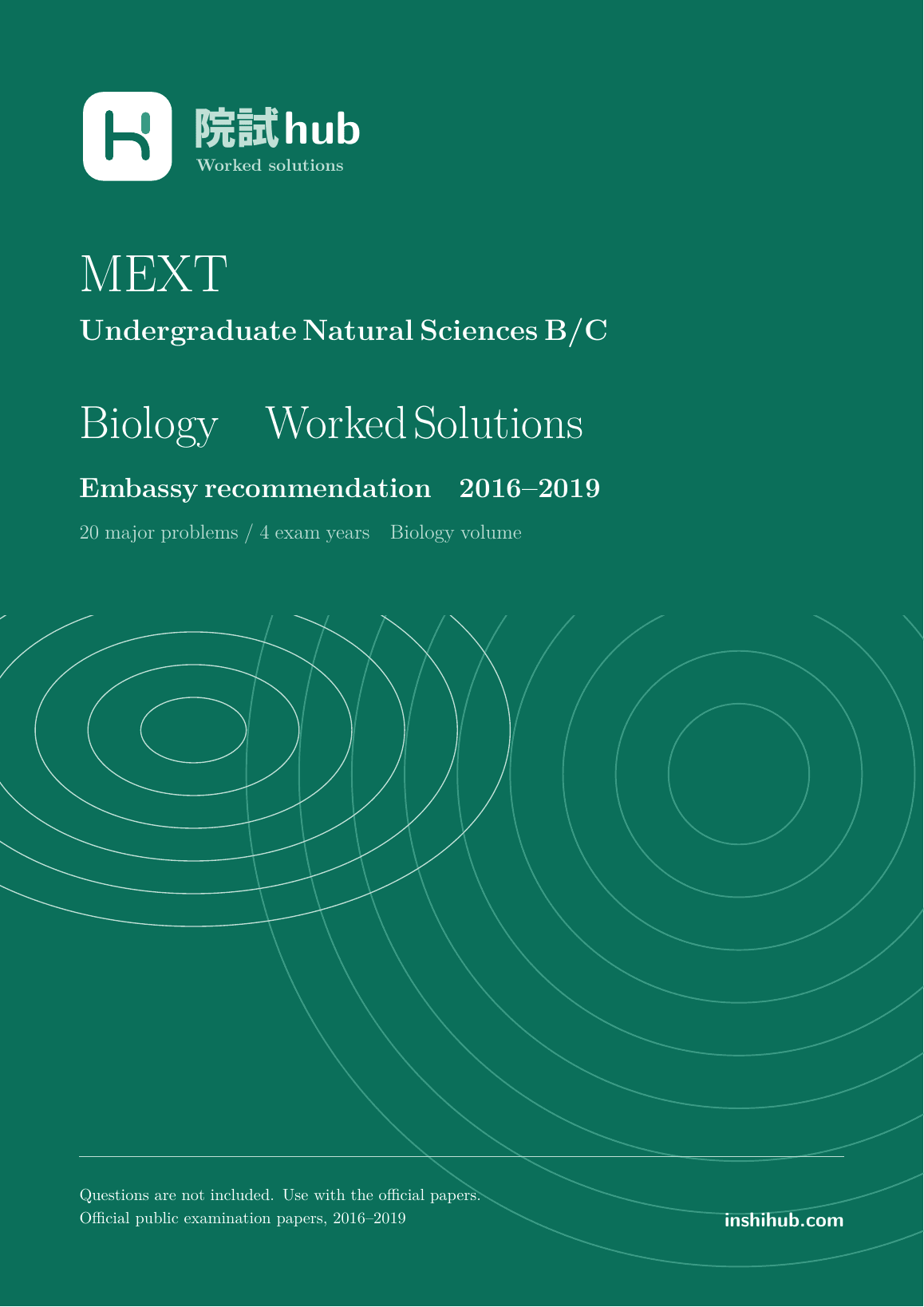
2016–2019 · Mathematics B, Chemistry & Biology
60 major problems · 176 worked units · 438 answer fields · 140 pages
English / A4 PDFs
See included papersSample worked solutions
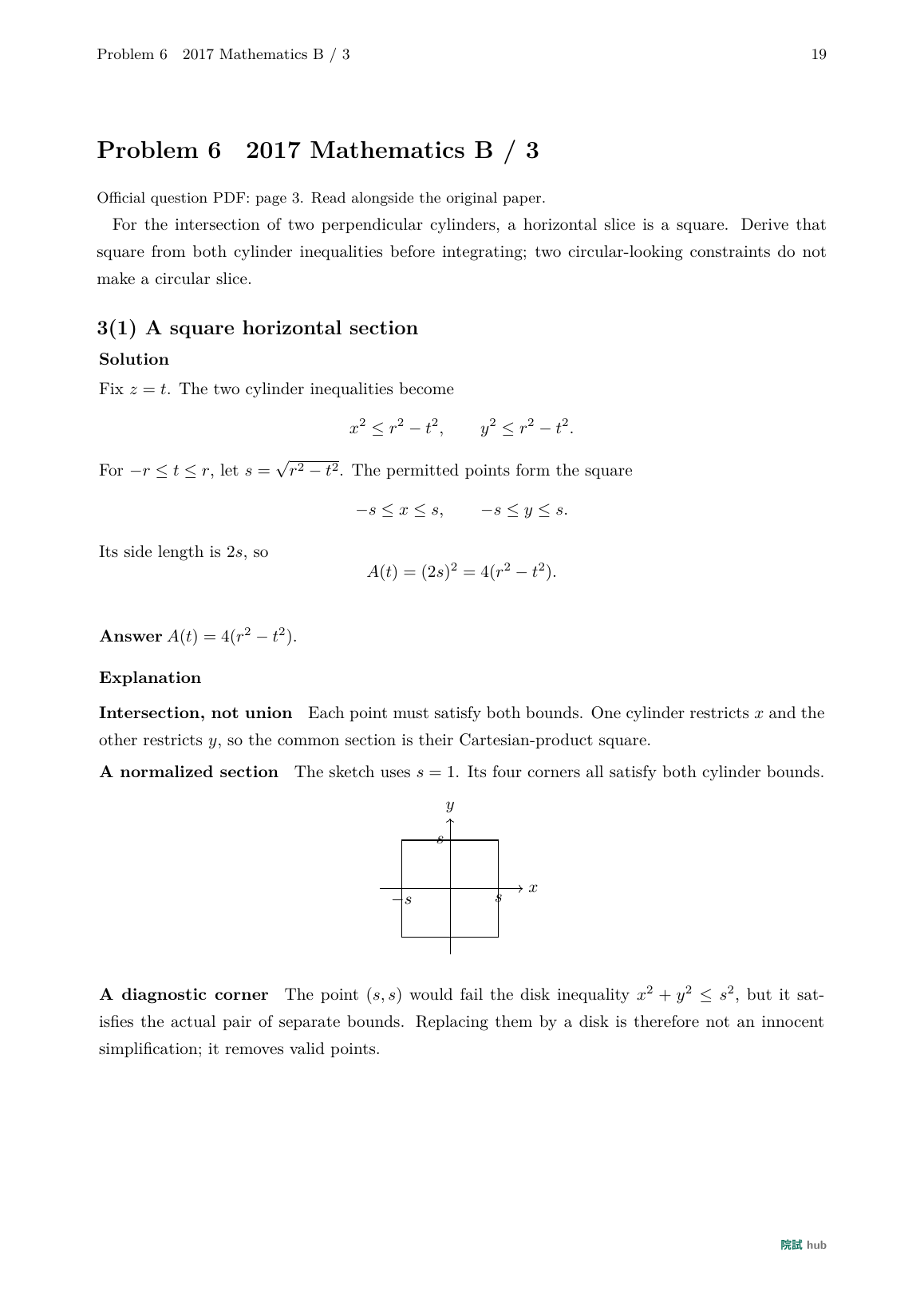
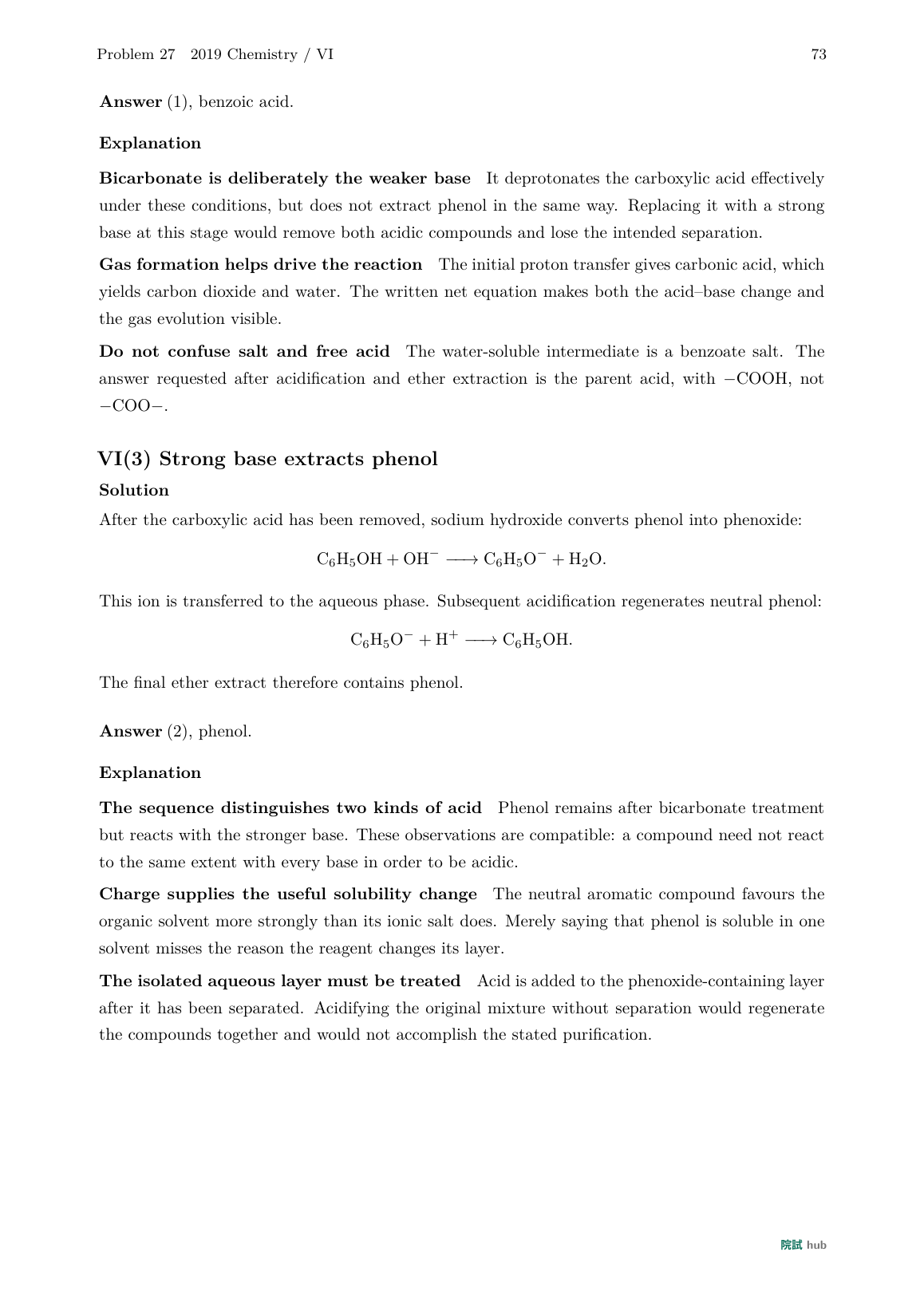
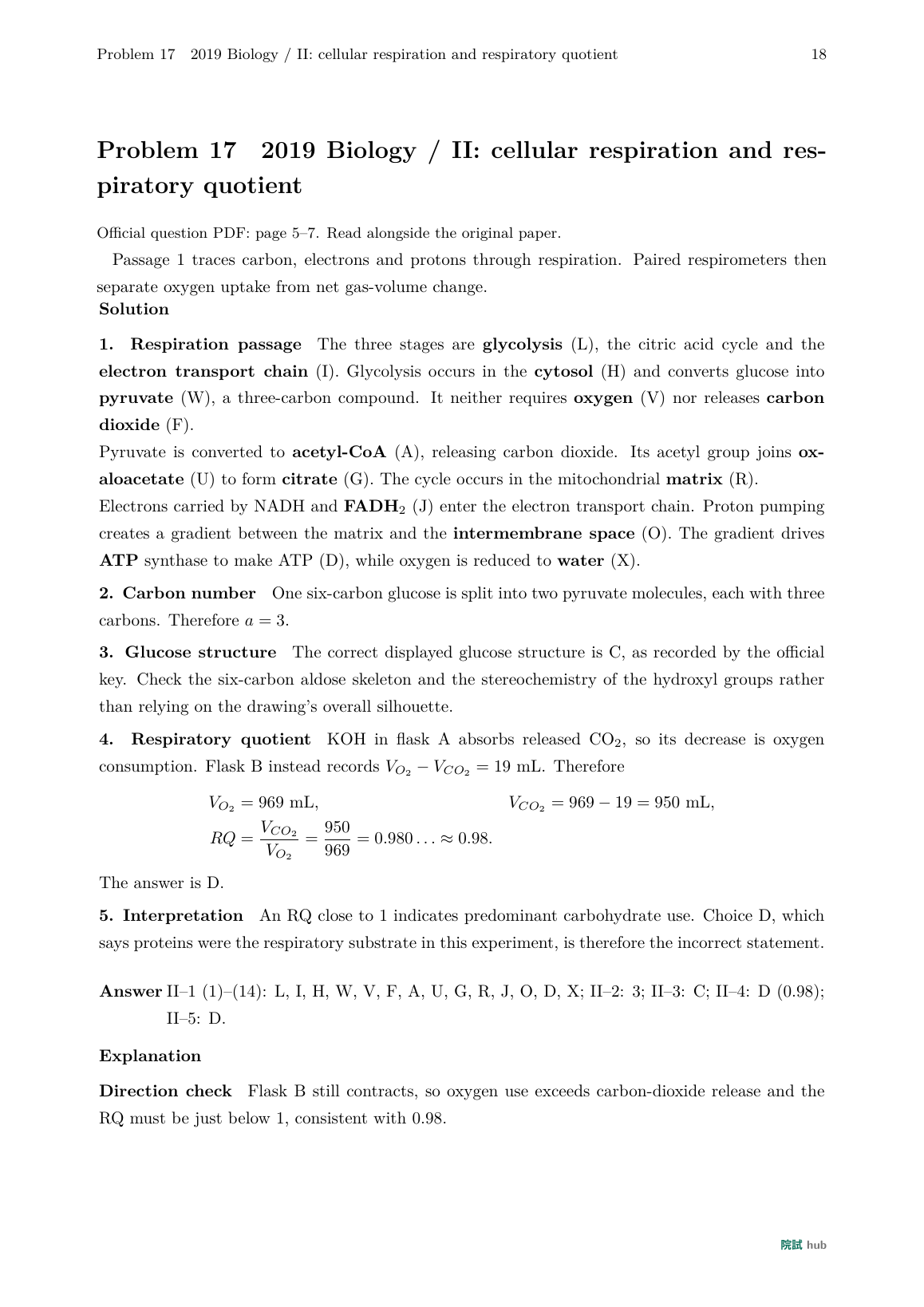
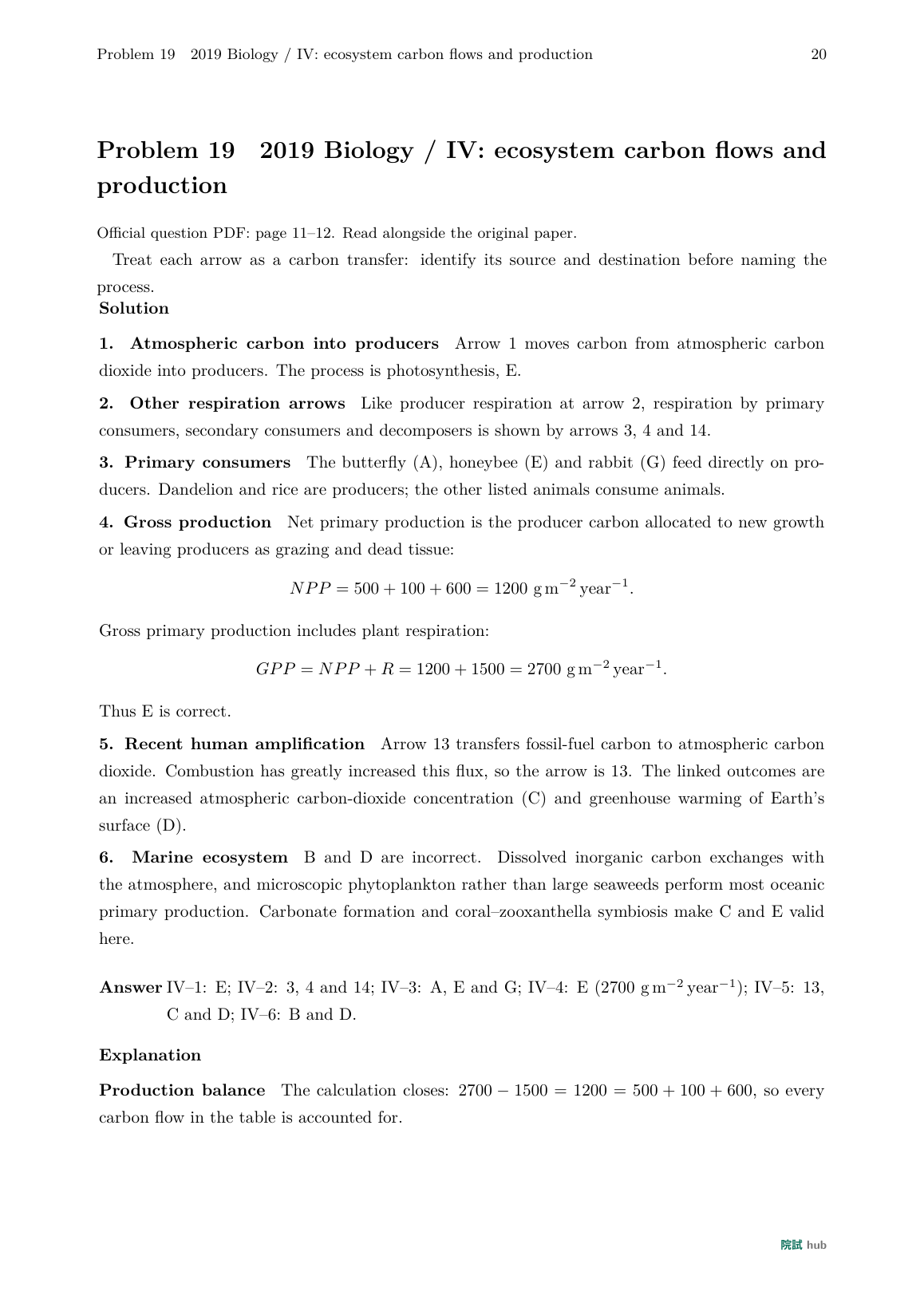
Open the 12-page sampleThe 12-page sample includes the three actual covers, the complete 2017 Mathematics B problem 3 on intersecting solids, the complete 2019 Chemistry problem VI on organic separation, and the complete 2019 Biology problems II–IV on respiration, circadian navigation and ecosystem production. Each extract retains its volume's printed page number. These are actual pages from the book. Select an image to read it at full size.
Included papers and topics
| Paper | Topics | Pages |
|---|---|---|
| 2016 · Mathematics B | Logarithms, trigonometry, route counting, cylindrical sections and iteration | 2–11 |
| 2017 · Mathematics B | Inequalities, unit fractions, parabolic areas and intersecting solids | 12–20 |
| 2018 · Mathematics B | Polynomial roots, complex numbers, tangent circles and integral identities | 21–29 |
| 2019 · Mathematics B | Divisors, plane geometry, digit counts, recurrences and ordered functions | 30–38 |
| 2016 · Chemistry | Acid-base titration, equilibrium, crystal density and aromatic isomers | 2–19 |
| 2017 · Chemistry | Electrolysis, gas equilibrium, formation energies and ester identification | 20–37 |
| 2018 · Chemistry | Solubility products, pH, organic reaction networks and back titration | 38–56 |
| 2019 · Chemistry | Gas mixtures, bond energies, organic separation and polymers | 57–78 |
| 2016 · Biology | Plant hormones, ecosystem diversity, osmoregulation, animal navigation and core definitions | 2–6 |
| 2017 · Biology | Mating systems, C3/C4/CAM photosynthesis, action potentials and developmental potency | 7–11 |
| 2018 · Biology | Land-plant evolution, cell biology, immunity, relatedness and eusociality | 12–16 |
| 2019 · Biology | Gene regulation, respiration, circadian clocks, ecosystem production and definitions | 17–21 |
Four years in each subject: 12 papers and 438 answer fields in total. Mathematics B has 47 worked units and 78 answer fields; Chemistry has 109 units and 156 fields; Biology has 20 major worked units and 204 fields. A worked unit may explain several related answer fields together. The 140-page total includes covers, reading notes and contents. Page ranges use the printed numbering within each volume.
Who this is for
Applicants preparing for the undergraduate Natural Sciences B or C written examinations who have studied secondary-school mathematics, chemistry and biology. Attempt an official paper first, then use the matching worked solution to locate the missing condition, reaction, biological distinction or numerical step. This is a past-paper companion, not a complete prerequisite course.
Not included
No Japanese or English language-test solutions, Physics, Mathematics A, research-student papers, college-of-technology papers or specialized-training-college papers. No papers outside 2016–2019, question translations, individual tutoring or scholarship guarantee. Eligibility and application procedures depend on the current guidelines and your Japanese embassy or consulate.
Natural Sciences A or B/C?
Choose by the category on your current application, not by which science feels easier. Natural Sciences A uses Mathematics B, Physics and Chemistry; Natural Sciences B/C uses Mathematics B, Chemistry and Biology. The Mathematics B and Chemistry papers are therefore shared. If you need Physics rather than Biology, buy the separate Natural Sciences A set. Buying both sets duplicates the Mathematics B and Chemistry volumes.
What the explanations add to the answer key
Mathematics B: check the admissible region
The 2017 square-root equation needs a sign condition before squaring, and the intersecting-solids problem needs the common cross-section rather than the sum of two sections. In the 2019 ordering problem, derivative signs on the stated interval determine which difference to integrate. The solution keeps each restriction beside the step that depends on it.
Chemistry: follow the species through each operation
The 2019 extraction problem distinguishes an amine, carboxylic acid, phenol and neutral compound by the ions produced at each wash. The 2016 crystal calculation also records the stated radius result, 0.40446… nm, beside the official key’s 0.41 nm so a rounding discrepancy is not mistaken for a chemical error.
Biology: connect the term to the mechanism
A respiratory quotient is derived from paired respirometers rather than recalled in isolation. Relatedness in haplodiploid insects is calculated through the parental paths, and ecosystem production is checked by closing the carbon balance. Vocabulary answers are tied to the property that distinguishes the correct option from its distractors.
How historical answer keys are handled
The Biology volume preserves the answer expected by each paper while identifying material caveats. The 2018 fern-life-cycle item records the published choice and explains why another printed statement also conflicts with the standard cycle. The 2019 human-origins item uses the paper’s approximately 200,000-year answer and notes that such dates are scientific estimates that may be revised. These are disclosed at the relevant problem rather than silently forcing current knowledge into an old key.
Does this cover every Natural Sciences B/C test?
No. The 2027 undergraduate guidelines list Japanese(B) and English(B) in addition to Mathematics(B), Chemistry and Biology for Natural Sciences B and C. This set covers only the three mathematical and science subjects. Calculators and other devices may not be used in the written examinations, so practise numerical work without one. Check the current official guidelines and your local Japanese diplomatic mission for eligibility, dates and application procedure.
Official question papers and answer keys
On the Study in Japan page, choose a year from 2016 to 2019, then Undergraduate Students and the relevant subject. Do not choose College of Technology or Specialized Training College. In the combined 2017 undergraduate answer PDF, Mathematics B is on physical page 3, Chemistry on pages 5–6 and Biology on page 7. The paid PDFs supply independently written worked explanations; the original questions and official keys remain available free at the source.
Independently written by InshiHub, not an official MEXT / Study in Japan publication and not affiliated with MEXT / Study in Japan. For corrections, email the subject, year, question number and issue to inshihub.com@gmail.com. About InshiHub (Japanese)
Payment, downloads and returns
One-time purchase, not a subscription. The listed price is in Japanese yen (JPY), not US dollars. Available payment methods and any local-currency quote appear at Stripe Checkout. Your bank may charge currency-conversion fees.
Download all 3 PDFs from the purchase-completion page after payment. Enter an email address you can receive mail at and retain the purchase email. Signed-in purchases can be retrieved from your account. Some delivery, email and account instructions are in Japanese.
Digital purchases cannot be cancelled or returned for a change of mind after payment. For a damaged file, non-delivery, a material mismatch with the description or a duplicate charge, we will provide a working file or the corresponding refund after verification. Contact the email above using your purchase email address and describe the product and issue.
Seller, contact details and full sales terms (Japanese) · Privacy policy (Japanese)